
SAP SuccessFactors Performance & Goals: Build a Continuous, AI-Enabled Performance Culture
IMPLEMENTATION ROADMAP
CONNECTED TALENT MODEL
RESPONSIBLE AI PRINCIPLE
NOT ANNUAL-ONLY
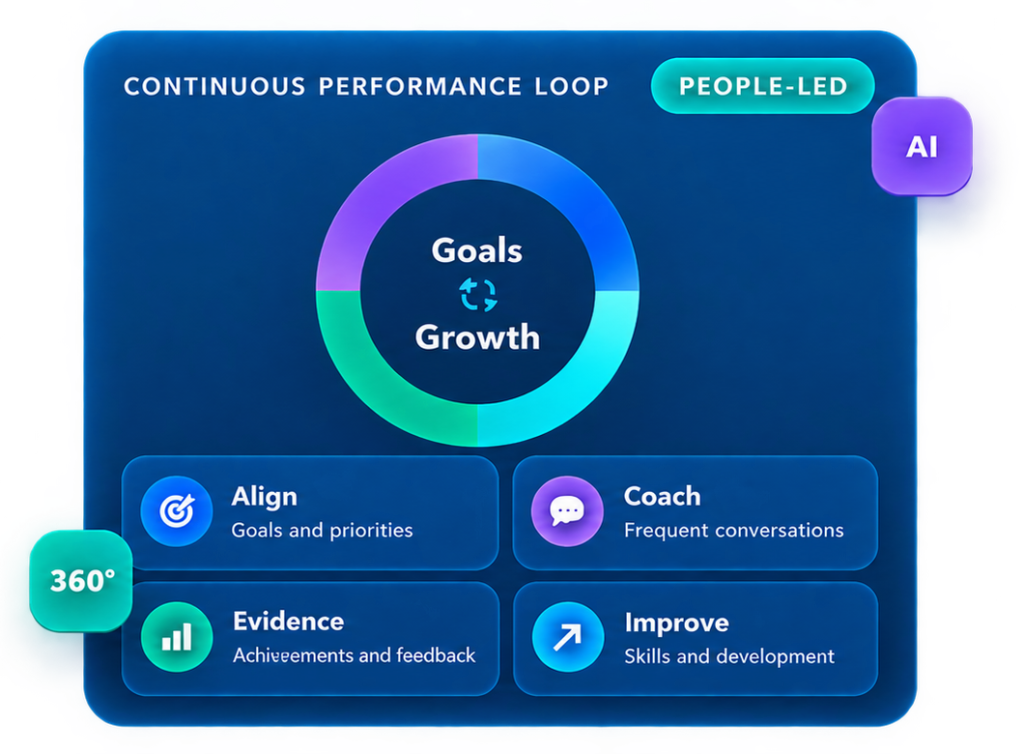
Performance management is moving away from a once-a-year administrative exercise. Organisations increasingly need clear goals, frequent coaching, evidence-based reviews and a consistent process that can work across teams, countries and employment models.
SAP SuccessFactors Performance & Goals brings goal management, performance assessment and continuous dialogue into a cloud-based talent environment. Used well, it can help employees understand priorities, give managers better information for coaching and create a more transparent basis for talent decisions. Used poorly, it can simply digitise an overcomplicated appraisal process.
SAP SuccessFactors Performance & Goals is a cloud performance-management solution within the SAP SuccessFactors HCM portfolio. It supports the alignment of individual and team goals with organisational priorities, structured performance reviews, continuous feedback and coaching, and data-informed talent conversations.
Current SAP capabilities also include AI-assisted goal creation, AI-assisted writing and performance insights, OKR support, skills-based assessments and the Performance Preparation Agent. Availability can depend on release status, licensing, SAP AI Units, permissions, locale and configuration, so the final solution scope should be confirmed during design.
| Traditional approach | SAP SuccessFactors-enabled approach |
|---|---|
| Annual review focused mainly on the past | Goals, achievements and coaching conversations maintained throughout the cycle |
| Goals stored in spreadsheets or local documents | Central goal plans with alignment, ownership, status and due dates |
| Manager-only perspective | Configurable self, manager and multi-rater inputs, including 360-degree reviews where in scope |
| Inconsistent forms and rating practices | Standard templates, routed workflows, permissions and review governance |
| Limited visibility until the review deadline | Dashboards, reminders and process status for managers and HR |
| Feedback separated from development | Achievements, feedback, skills and development actions can inform performance conversations |
The platform enables this operating model, but it does not guarantee better conversations. Manager capability, simple process design, employee trust and responsible use of data remain decisive.
Translate organisational priorities into measurable individual and team goals, with clear ownership and progress.
Use regular manager-employee conversations to address progress, obstacles and changing priorities while action is still possible.
Use regular manager-employee conversations to address progress, obstacles and changing priorities while action is still possible.
Use reviews and insights to drive learning, development and mobility actions—not merely to record a rating.
Goal management and alignment
Organisations can create individual, team and organisational goals, cascade or align them to strategic priorities and track progress across the cycle. Goal libraries, weights, milestones, measures and configurable fields can support consistency while allowing appropriate local flexibility. OKRs can also be used to connect dynamic team outcomes with individual performance goals.
Structured performance reviews
Configurable performance forms can bring goals, competencies, skills, ratings and comments into a controlled review workflow. Route maps, role-based permissions, reminders and completion monitoring help HR administer the cycle across large or distributed workforces.
Continuous performance and feedback
Continuous Performance Management supports regular activities, achievements, meeting notes and coaching conversations. Employees and managers can maintain evidence throughout the year rather than reconstructing performance at the deadline. Feedback can be requested closer to the work, making it more specific and actionable.
360-degree reviews
Collect structured input from selected colleagues and stakeholders where in scope. Govern confidentiality, rater selection, question design and interpretation carefully.
Calibration and consistency
Review ratings or talent data across teams, identify inconsistencies and document calibrated outcomes. Challenge evidence and standards rather than forcing a distribution.
Connected talent decisions
Use achievements, goals, feedback and skills to inform learning, development, succession, mobility and compensation processes across the wider ecosystem.
These should be treated as measurable programme objectives, not guaranteed software benefits. Baseline the current process and agree target measures before implementation.
SAP continues to add AI capabilities across Performance & Goals. Depending on licensing and configuration, these can support:
- Drafting more measurable personal or team goals from employee input.
- Generating or improving comments for goals, competencies and skills.
- Summarising performance evidence into strengths, achievements, development areas and discussion points for managers.
- Preparing managers for one-to-one and review conversations through the Performance Preparation Agent.
Human accountability remains essential:
AI output should remain a recommendation. Managers and employees need to review it for accuracy, context, fairness and appropriate language. Role-based access, transparency, data minimisation and human accountability should be included in the AI governance model.
01
Stronger alignment between organisational priorities and individual contribution.
Faster intervention when goals, workload or capability requirements change.
02
Better-quality performance conversations supported by current evidence.
03
More consistent administration across departments, entities and countries.
04
Improved visibility of review completion, overdue steps and manager adoption.
05
A clearer connection between performance, skills, learning, development and mobility.
06
| Organisational context | Why the solution may fit |
|---|---|
| Growing organisation | Standardises goal and review processes as manager layers, roles and locations expand. |
| Multi-country or multi-entity workforce | Provides a common framework with controlled local variations, permissions, language and workflow considerations. |
| Spreadsheet-based performance process | Moves data, approvals and status tracking into a governed cloud workflow. |
| Continuous-feedback strategy | Supports regular achievements, coaching notes, activities and feedback rather than an annual-only event. |
Skills-based talent strategy | Can connect performance conversations with skills and development data across the SuccessFactors ecosystem. |
| OKR or dynamic-team model | Provides visibility into team outcomes and their relationship to individual goals, subject to configured capabilities. |
The most successful programmes define the operating model first and configure the technology around real employee and manager journeys. Select a step to explore the roadmap.
Seven connected phases · select a step to explore
Step - 1
Define the performance philosophy
Decide the purpose of performance management, the role of ratings, the balance between accountability and development, and how outcomes connect to reward, learning or succession.
Step - 2
Simplify and standardise the process
Remove unnecessary form sections, duplicate approvals and rating complexity. Define the global model and the limited variations required for legal, works council, language or business needs.
Step - 3
Design goals, forms and workflows
Configure goal fields, alignment rules, skills, review sections, route maps, rating scales, signatures, reminders and permissions around real user journeys.
Step - 4
Plan integrations and data governance
Confirm employee and organisational data sources, identity, permissions, retention, reporting, learning or compensation touchpoints and analytics requirements.
Step - 5
Test with realistic scenarios
Run unit, integration, security, workflow and UAT across employees, matrix managers, transfers, leavers, proxy access, missing data, reopened forms and country variations.
Step - 6
Prepare managers and employees
Use role-based training, example goals, conversation guides, office hours and manager communities. Explain data visibility and how AI suggestions must be reviewed.
Step - 7
Measure adoption and improve
Monitor completion and experience quality after launch. Use the first cycle to simplify forms, refine guidance and target coaching where adoption is weak.
| Risk | Control or design response | |
|---|---|---|
| Digitising a poor process | Challenge each form field and approval against a clear business purpose; simplify before configuring. | |
| Inconsistent goal quality | Use examples, goal libraries, measurable fields, manager review and AI assistance with human validation. | |
| Rating bias or inconsistency | Train managers, define evidence standards, use structured calibration and monitor patterns without assuming technology removes bias. | |
| Low manager adoption | Design around manager workload, provide practical coaching tools and measure timeliness and quality - not only login activity. | |
Privacy or employee-relations concerns | Complete privacy, legal and works council reviews; define visibility, retention, access logging and acceptable use of notes and AI. | |
| Overreliance on AI output | Keep a human decision-maker accountable, disclose AI-assisted steps and require review for accuracy, tone and fairness. | |
| Weak integration data | Validate hierarchy, manager relationships, job and location data before launching forms; define ownership for corrections. |
Completion rate matters, but it is not enough. Combine administrative, behavioural and outcome indicators:
01
Percentage of employees with approved, measurable goals by the target date.
Goal updates, achievements and feedback recorded throughout the cycle.
02
03
Frequency and timeliness of manager-employee check-ins.
03
03
03
03
03
03
- Performance-process assessment and global template design
- Goal Management, Performance Management and related talent configuration
- Role-based permissions, workflow, form and notification design
- Integration, data validation, reporting and security testing
- User acceptance testing, training and change enablement
- Release management, continuous improvement and application support
Start with a performance-process design workshop involving HR, managers, employees, HRIT, privacy and employee-relations stakeholders. The outputs should define the future process before configuration begins.
What is SAP SuccessFactors Performance & Goals?
Does it support continuous performance management?
Yes. Continuous Performance Management can support ongoing activities, achievements, meeting notes, coaching and feedback, helping organisations move beyond an annual-only review.
Can SAP SuccessFactors support 360-degree feedback?
Yes. SAP SuccessFactors includes 360 Reviews capabilities for collecting structured input from selected raters. Confirm licensing, permissions, confidentiality rules and the intended use of feedback during design.
Does the solution use AI?
SAP provides AI-assisted capabilities for goals, writing, performance insights and manager preparation. Availability may require specific releases, permissions, configuration, licensing or SAP AI Units. Human review and accountable decision-making remain essential.
Can Performance & Goals integrate with other SuccessFactors modules?
Yes. It can operate within the wider SuccessFactors HCM ecosystem, including employee data, skills, learning, development, succession and compensation processes. The required data flows and dependencies should be designed and tested explicitly.
Is the solution suitable for mid-sized organisations?
It can be, especially where the organisation needs a structured, scalable process across growing teams or locations. The business case should consider process complexity, user numbers, licensing, administration and change-management capacity.
How long does implementation take?
The timeline depends on scope, countries, templates, integrations, data quality, security, testing and change readiness. A focused global template can be faster than a multi-country transformation with extensive local variations.
Specific IT Needs?
Your IT challenges aren’t one-size-fits-all.
Unlock a custom strategy designed for your growth and transformation.
Lorem ipsum dolor sit amet, consectetur adipiscing elit. Ut elit tellus, luctus nec ullamcorper mattis, pulvinar dapibus leo.