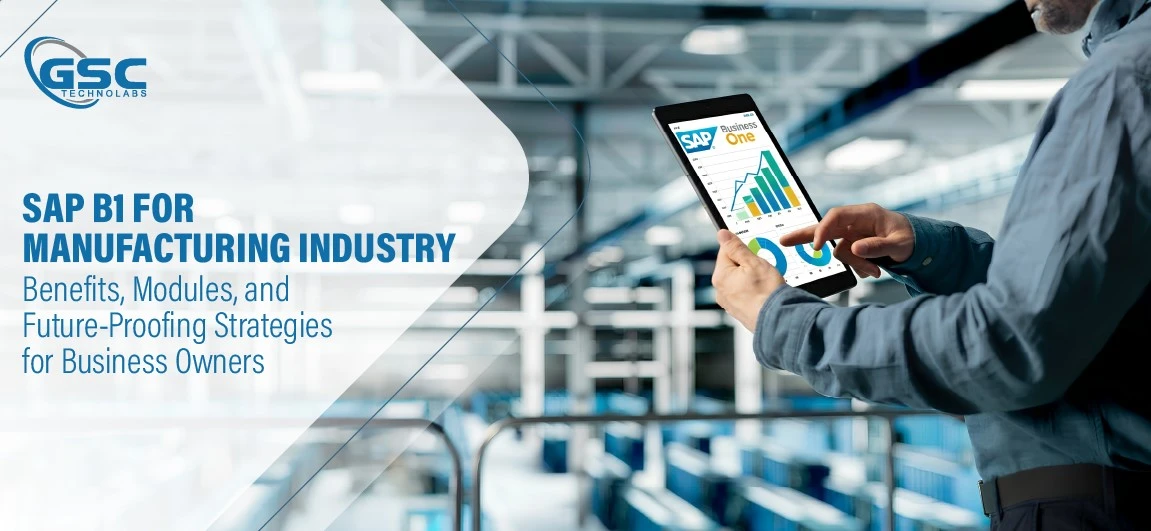
SAP B1 for Manufacturing Industry:
Benefits, Modules, and Future-Proofing Strategies for Business Owners

SAP B1

Is your manufacturing business truly ready for the future - or is it struggling in silos, complexity, and stagnation?

Introduction


The three key demands of business owners in the modern manufacturing world, where time is of the essence, are efficiency, quality, and flexibility. Whether it is the complexity of production lines, the ability to ensure consistent quality, or the ability to respond quickly to market needs, contemporary manufacturers require a combination of smartness and unity that aligns business objectives with activity.

That is where the SAP Business One (SAP B1) comes in. It is not simply an ERP but a strategic enabler that aims to provide all manufacturing businesses, whether big or small, with visibility, control, and scalability. SAP in the manufacturing industry simplifies operations, minimizes operational expenses, and enhances flexibility for companies.

We will see how SAP ERP manufacturing can help business owners overcome challenges, streamline processes, and lay a foundation for future growth.

How Does SAP Business One Differ from Other ERP Systems?

SAP Business One is differentiated from other ERP systems by several characteristics that align it uniquely as a tool for SMEs.

  • Scalability and Affordability:
    SAP Business One, unlike extra-large flexible licensing, does not require a large upfront cost; you can choose the one that fits your business perfectly, and the cost is very flexible. Simply adding the parts of the programme you want to use, and the number of users you want to have will allow your business to grow as it grows.
  • Industry-Specific Solutions:
    SAP Business One offers ready-made industry configurations for manufacturing, retail, services, and distribution. These industry-specific software solutions comprise business processes, reports, and workflows designed to meet the requirements of specific industries.
  • Rapid Implementation:
    The implementation period for large-scale ERP is years or months, whereas that of SAP Business One is usually a few weeks or months, thereby reducing business interruption time and providing a faster return on investment.
  • User-Friendly Interface:
    The system has a user-friendly, Microsoft Office-like interface that reduces training time and improves user adoption. The user-friendliness of the English language helps the staff to get used to the new programme in no time.
  • Comprehensive Integration:
    SAP Business One integrates with all major third-party software, including Microsoft Office, e-commerce platforms, and industry-specific software, enabling data to flow effortlessly between systems.

Knowing the Requirements of the Contemporary Production

Manufacturing firms today must deal with global supply chains, volatile raw-material prices, and changing customer expectations. Efficiency and precision are not luxuries; they are necessities.

SAP B1 is the brain of your business, linking all operations of your business, namely, procurement, production, finance, and sales into a single digital environment.

SAP B1 gives manufacturers ultimate control over their production, real-time decision-making analytics, and complete traceability of processes and materials.

Such a combined strategy benefits entrepreneurs:
  • Real-time monitoring of the production cycles.
  • Monitor stock movements accurately.
  • Automate the material planning and procurement.
  • Make better decisions based on precise data.

These capabilities enable SAP B1 to help manufacturers remain competitive in dynamic markets.

Top SAP B1 Modules & Functionalities for Manufacturing

SAP B1 offers a unified ERP ecosystem that encompasses all key manufacturing activities. Now we will get into the most effective SAP manufacturing modules that lead to operational excellence.

  • Production and Bill of Materials (BOM)
    The SAP B1 Production module is an effective tool for managing production orders, resources, and materials. It enables manufacturers to develop and manage multi-level BOMs, which identify all the raw materials, subassemblies, and components needed to build a product.
  • Material Requirements Planning (MRP)
    The MRP module in SAP B1 automates material planning, including balancing demand and supply. It stipulates the availability of the right material at the right time, thereby avoiding production delays and overstocking.
  • Inventory and Warehouse Control
    SAP B1 allows manufacturers to manage a variety of warehouses, batches, and serial numbers, and to optimize stock levels. Real-time updates reduce waste and improve the accuracy of order fulfillment.
  • Procurement and Purchasing
    The system automatically handles the purchase request, approvals, and supplier management, which are linked to the production needs.
  • Sales and Distribution
    This module integrates the sales forecast and production planning for effective delivery of products and orders on time.
  • Finance and CostingSAP B1 connects all production events to financial results; it enables real-time cost tracking, variance analysis, and profitability control.
  • Management of Quality and Compliance

    SAP B1 provides the possibility of quality control with the help of batch tracking, inspection management, and compliance documentation, which are required in the regulated markets such as pharmaceuticals or food processing.

    These SAP ERP manufacturing modules, when combined, align operations so that all resources are optimized and all processes provide measurable value.

Challenges Faced by Manufacturing Business Owners Today and How SAP B1 Solves Them

Despite technological advancements, many manufacturers continue to experience operational inefficiencies. We will analyze the major challenges and how they are addressed using SAP B1.

Challenge How SAP B1 Solves It
Disconnected systems & data silos SAP B1 integrates all business functions sales, procurement, production, and finance eliminating data duplication and improving coordination.
Inventory inaccuraciesReal-time stock updates, batch tracking, and MRP prevent overstocking and stockouts.
Production delaysThe system automates production scheduling and resource allocation to minimize downtime.
High operational costsBy optimizing procurement and inventory, SAP B1 reduces waste and unnecessary expenses.
Limited decision-making insightsInteractive dashboards and analytics provide executives with real-time visibility.
Compliance issuesSAP B1 maintains traceability and documentation for audits and quality checks.

According to the sources, production inefficiencies can be reduced by up to 30 percent in businesses using SAP B1 through improved visibility and process automation.

Why SAP Business One Is the Right Choice for SMB Manufacturers

  • SMB Manufacturers Customized
    SAP B1 is a small, mid-sized manufacturer-specific ERP system that provides full ERP functionality at a lower cost than large, very complex ERP systems.
  • Coherent Business Processes
    The SAP B1 is a system that combines production, accounting, inventory, and sales. There is no longer a need to juggle different software or spreadsheets.
  • Scalability and Flexibility
    SAP B1 scales without any hassle, be it in a single plant or worldwide. You can add modules, users, and functions as you expand.
  • Cost-Effective Implementation
    SAP B1 offers better ROI than standard enterprise systems, whether in the cloud or on-premises.
  • Proven Track Record

    SAP B1 provides reliability and accuracy while enabling change to business requirements, which has made thousands of manufacturers across the world trust SAP B1.

    As B1 Solutions notes, SAP for manufacturing industry helps businesses transition from reactive operations to proactive management—boosting efficiency and profitability.

Real-World Value for Your Business

Any ERP is successful when it delivers quantifiable results. This is how the SAP B1 can bring real-life value to manufacturing firms:

  • Operational Efficiency
    Manufacturers who use SAP B1 report that production planning efficiency has increased by 20-30% due to improved coordination among departments.
  • Cost Reduction
    SAP SilverTouch states that using automated inventory control and precise forecasting can reduce working capital costs by 15-20 percent.
  • Enhanced Decision-Making
    The real-time reports and dashboards enable faster response to changing demand or production status.
  • Better Compliance and Control of Quality
    The batch traceability features and documentation ensure compliance with ISO, FDA, or local quality standards.
  • Scalable Growth

    As the business continues to grow, SAP B1 can expand: it can be extended to a new production line, a new geographic market, or an industry-specific add-on.

    To put it briefly, SAP B1 transforms data into actionable insights, helping the manufacturer make smarter, faster, and more profitable decisions.

A Step-by-Step Approach to Implementing SAP B1 in Manufacturing

A planned strategy determines success in implementation. Here’s a practical roadmap:

Step 1: Scoping and Objectives

  • Finding specific business objectives, cost-cutting, increased visibility, or improved production cycles.
  • Define scope: manufacturing planning, stock, purchasing, quality control, etc.

Step 2: Evaluate Existing Processes

  • Map processes and pinpoint gaps.
  • Collect good master data (BOMs, supplier information, inventory records).

Step 3: Select a Partner with Experience

  • Choose an SAP-certified company specializing in manufacturing, such as Accelon Technologies.

Step 4: Configure Core Modules & Customize Addon

  • Create BOM, production orders, and resource planning.
  • MRP and costing settings.
  • Determine warehouse design and serial/batch tracking.
  • Addon as per customization
  • Customize Add Ons

Step 5: Data Migration and Testing

  • Provide go-live with validated accuracy, workflows, and data integrity through simulation.

Step 6: Training and Change Management

  • Train on using SAP B1 to prevent resistance and achieve adoption.

Step 7: Continuous Improvement and Go-Live

  • Beginning with a pilot, track KPIs (cost, delivery, yield), and continuously improve processes.

Future-Proofing Your Manufacturing Business with SAP B1

The manufacturing landscape is evolving rapidly; smart factories, IoT integration, and predictive analytics are no longer luxuries.

SAP B1 is ready to help your business embark on this digital transformation. It is competitively extended in the long run with in built analytics, mobile access, and connection with technologies such as AI and machine learning.

Centralization allows SAP B1 to:
  • Machine data-based predictive maintenance.
  • Analytics-based demand forecasting.
  • Reduced time to introduce new products.

This not only transforms SAP B1 into an ERP, but also a digital foundation for the future of manufacturing.

Frequently Asked Questions

Can SAP B1 be used with small and medium manufacturers?

Yes. SAP B1 is designed to support small- and mid-sized manufacturing companies by offering enterprise-level capabilities at an affordable price.

The important modules are Production, MRP, Inventory Management, Procurement, Costing, and Analytics.

Normally, 5-9 months, depending on the size and complexity of the company’s processes.

Yes. SAP B1 also supports batch tracking and traceability, as well as documentation to meet ISO and FDA requirements.

SAP B1 will ensure your operations are Industry 4.0-ready and beyond because of its ability to scale, connect with smart manufacturing devices, and deliver real-time analytics.

Conclusion

Visibility, agility, and data-driven decision-making are the keys to the sustainable growth of manufacturing business owners. SAP Business One is a solution that combines all this – an intelligent ERP that pulls together your production, operations, and financials into one cohesive solution.

By adopting SAP B1, you gain:

  • On-site production management.
  • Greater accuracy of inventory.
  • Cost efficiency
  • Quality and compliance assurance.
  • Future expansion.

B1 Solutions and SAP B1 are designed to enable manufacturers not only to survive but also to be the best in a highly competitive global market.

GSC Technolabs logo

GSC Technolabs provides end-to-end IT solutions committed to helping businesses modernize and grow with confidence. From cloud transformation and cybersecurity to enterprise software implementation, application development, and data-driven insights, we deliver tailored solutions that combine technical expertise with a customer-first approach. We enable organizations to streamline operations, enhance performance, and achieve long-term growth.