SAP BTP Explained: Core Pillars, Benefits & Why Businesses Should Adopt It
Today, the digital era calls for agility, intelligence, and innovation that can be scaled. SAP Business Technology Platform (SAP BTP) has become a key factor in facilitating enterprises’ integration, development, analytics, and automation as they speed up their transition to the cloud. In fact, SAP BTP is a single platform that offers limitless possibilities with its next-generation technologies for building intelligent business applications, SAP landscape modernization, or a simple extension of SAP applications.
The detailed guide is essentially a resource explaining the concept of SAP BTP, its main pillars, benefits, industry-specific applications, and the reasons why companies should make use of it to remain digitally successful in the long run.
What Is SAP BTP?
Enhance the current SAP applications
Create new cloud-native applications
Integrate SAP and non-SAP systems
Automate
workflows
Utilize up-to-the-minute insights
Enable intelligent business processes
Put simply, SAP BTP serves as the technical backbone that links up people, processes, data, and systems. Given its modular services and open architecture, companies are free to innovate at their own speed while being assured of a smooth integration with SAP’s digital roadmap.
SAP BTP is composed of four main pillars, each offering specific capabilities that are indispensable for a digital transformation.
It enables professional developers and business users to build and extend applications quickly while keeping core SAP systems clean and stable.
Key capabilities include:
- SAP Build Apps (low-code/no-code development)
- SAP Build Process Automation
- SAP Business Application Studio
- Workflow automation
- Citizen development
This approach accelerates solution delivery while empowering both IT teams and business users to contribute to digital innovation.
It enables organizations to turn data into actionable insights by making data access, processing, and visualization seamless and real-time. By unifying analytics and advanced data processing, businesses can make faster, smarter, and more informed decisions.
Key capabilities include:
- SAP HANA Cloud
- SAP Analytics Cloud
- Data modeling and governance
- Predictive analytics
- Real-time dashboard
This foundation allows enterprises to gather data from multiple sources and transform it into insights that directly support strategic and operational decisions.
It enables enterprises to operate as a connected ecosystem by ensuring seamless data and process flow across applications, systems, and environments. With reliable integration, business processes run continuously without delays or manual intervention.
Key capabilities include:- SAP-to-SAP integration
- SAP-to-non-SAp integration
- On-permise to cloud connectivity
- APIs and connectors
- Event-driven architectures
- B2B and B2G integrations
This ensures that business processes remain synchronized and information moves effortlessly across the enterprise landscape.
SAP BTP can help businesses to integrate artificial intelligence, machine learning, and intelligent automation directly into their applications and business processes. This pillar assists organizations to go beyond the reactive decision-making to predictive and prescriptive intelligence which produces smarter outcomes at scale.
Through the integration of data, analytics, and AI services, SAP BTP enables businesses to establish smart and self-educating systems that will never stop enhancing business performance.
Key capabilities include:- SAP AI Core and AI Launchpad to oversee AI life cycle.
- Predictive analytics services by machine learning.
- AI-based in-app functionality of SAP apps (Finance, HR, Supply Chain, CX).
- Conversational AI & chatbots
- Recommendation engines
- Document and image processing.
- Prescriptive analytics and predictive analytics.
SAP BTP provides a wide variety of long-term and short-term advantages that are able to assist any organization in its modernization and expansion processes in an efficient way.
1. Unified Digital Foundation
SAP BTP is a single platform that supports analytics, integration, AI, automation, and extensibility. In this way, the complexity is lowered, and the need for several separate tools is totally eliminated.
2. Seamless Integration with SAP & Non-SAP Systems
SAP Integration Suite is the tool that allows organizations to connect all the applications running in the enterprise and thus gain better visibility of the processes and business continuity.
3. Faster Innovation with Low-Code Tools
SAP Build makes it possible to accomplish tasks such as prototyping, app development, and workflow automation in a much shorter time period, thus reducing IT dependency, and innovative projects get accelerated.
4. Enhanced Data Management & Real-Time Insights
Employing SAP HANA Cloud along with SAP Analytics Cloud, businesses are capable of merging their data and getting the necessary insights for more accurate decision-making at the strategic level.
5. Improved Operational Efficiency
The automation initiatives are usually responsible for lessening the manual efforts, facilitating the processes, and giving the staff the ability to work on high-value tasks.
6. Flexible Extensibility
Comprises the features of side-by-side extensions, enterprises are allowed to evolve SAP S/4HANA, SAP SuccessFactors, or SAP ECC, while at the same time, they have no interference with the operation of the core systems.
7. Cost Optimization
By using a pay-as-you-go model and having modular, consumption-based services, the organizations are capable of managing their expenses and only investing in the functionalities that interest them.
8. Enterprise-Grade Security
Secure cloud operations are guaranteed by built-in identity management, compliance standards, and data protection.
1. Extend HR Processes With Custom Apps
Creating workflows, portals, onboarding tools, and employee self-service apps that go hand in hand with SuccessFactors.
2. Integrate HR with Finance, IT & Operations
Without any kind of interruption, the data can flow from one source to another, e.g., payroll, finance, compliance, and workforce management tools etc.
3. Optimize Employee Experience
By means of analytics and automation, a company is able to offer faster approvals, personalized dashboards, and AI-driven recommendations.
SuccessFactors, along with SAP Analytics Cloud, is a single comprehensive view of workforce performance.
5. Future-Proof HR SystemsBTP offers cloud-native extensibility, which allows HR systems to remain up-to-date without the need to change the core SuccessFactors code.
SAP BTP is valuable across industries because it provides solutions tailored to industry-specific challenges.
-
Smart factory automation
-
Predictive maintenance
-
IoT-driven production insights
-
Integrated supply chain visibility
-
Personalized recommendations
-
Real-time inventory insights
-
Omnichannel integrations
-
Automated order processing
-
Patient data integration
-
Predictive analytics for care management
-
Compliance-driven data governance
-
Interoperability across systems
-
Fraud detection
-
Automated reporting
-
AI-backed risk assessment
-
Enhanced customer authentication
-
Billing automation
-
Workforce planning
-
Project analytics
-
Integrated CRM & ERP workflows
-
Citizen service portals
-
Smart city solutions
-
Streamlined document workflows
-
Enhanced data transparency
Organizations can adopt SAP BTP in a well-planned, strategic way:
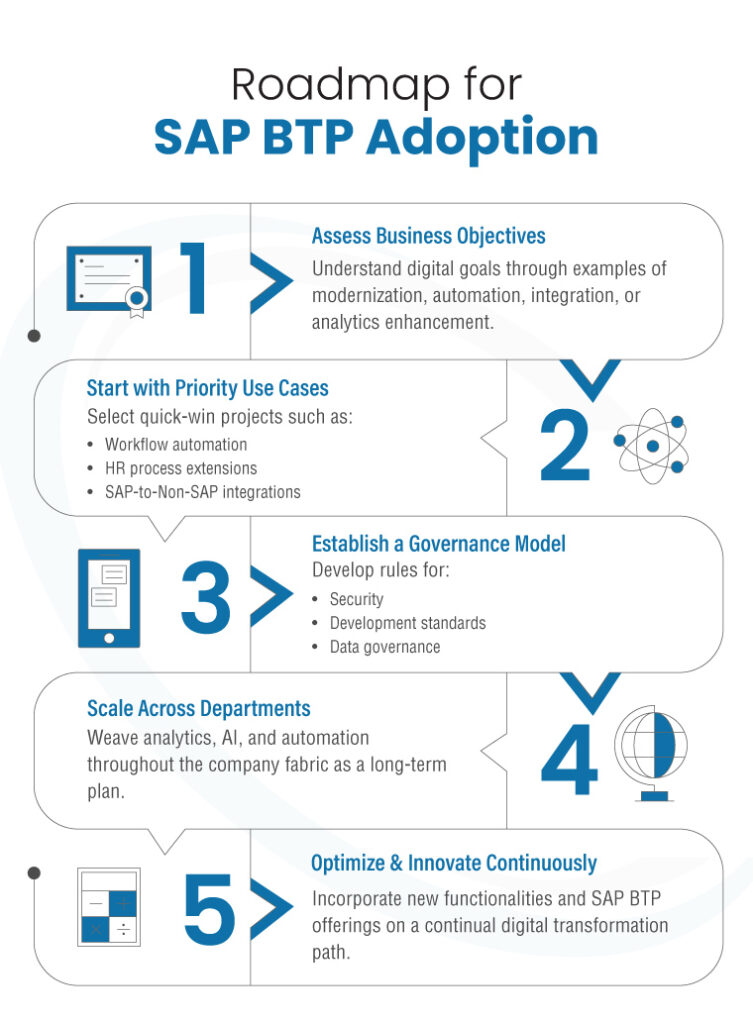
Understand digital goals through examples of modernization, automation, integration, or analytics enhancement.
Step 2: Start with Priority Use Cases
Select quick-win projects such as:
- Workflow automation
- HR process extensions
- SAP-to-Non-SAP integrations
Develop rules for:
- Security
- Development standards
- Data governance
Weave analytics, AI, and automation throughout the company fabric as a long-term plan.
Incorporate new functionalities and SAP BTP offerings on a continual digital transformation path.
What is SAP BTP?
How does SAP BTP improve operational efficiency?
Which industries can benefit from SAP BTP?
How does SAP BTP support innovation?
What makes SAP BTP reliable for enterprises?
Is SAP BTP expensive?
Does SAP BTP work with non-SAP systems?
Can small businesses use SAP BTP?
What is the best SAP Business Technology Platform setup for a mid-size manufacturing business?
SAP Business Technology Platform helps businesses integrate systems, manage data, build applications, automate workflows, and use AI-driven analytics to improve decision-making and business processes.
What does SAP BTP do?
A mid-size manufacturing company can use SAP Business Technology Platform with SAP Integration Suite for system connectivity, SAP HANA Cloud and SAP Analytics Cloud for real-time production insights, and SAP Build for creating custom apps and workflow automation. This setup improves supply chain visibility, predictive maintenance, and operational efficiency.
How can a company simplify SAP BTP adoption?
Companies can simplify adopting SAP Business Technology Platform by starting with small use cases, using low-code tools like SAP Build, integrating systems through SAP Integration Suite, and gradually scaling across departments.
Final Thoughts
SAP BTP goes beyond being just a technology platform; it is a strategic enabler that supports businesses to innovate, integrate, and scale with great efficiency. By its strong pillars, sector-specific benefits, and comeback architecture, SAP BTP is a powerhouse that enables organizations to revolutionize their operations, get insights from data, and speed up their digital transformation.
In case you are merely extending SAP systems, modernizing applications, or inventing smart solutions, a commitment to SAP BTP is a sure way to keep your company agile, competitive, and prepared for the challenges of tomorrow.
Specific IT Needs?

GSC Technolabs is committed to helping businesses modernize and grow with confidence through SAP solutions. We help organizations to streamline operations, improve efficiency, and achieve sustainable though our expertise in SAP consulting, implementation, integration & support services.