How to Choose the Right ERP Vendor for Long-Term Business Growth along with ERP System

Choosing the right ERP vendor is one of the most critical decisions a business can make. An effective ERP system can simplify functions, improve efficiency, and give real-time reporting on the performance of the organization.
Nevertheless, the possibility of selecting the wrong ERP is the risk of wasting resources, misplaced implementation, and operational issues in the long term. This is the reason why the process of picking an ERP system cannot be a mere buying process, but rather it is a business strategy.
An ERP vendor is a software provider that creates, markets, and maintains Enterprise Resource Planning (ERP) solutions. These systems unify essential business functions, such as finance, human resources, manufacturing, and supply chain, into one integrated platform.
The vendor ensures smooth implementation, regular updates, technical support, and ongoing maintenance to help organizations improve efficiency and streamline operations.
To start with, when selecting an ERP system, you need a clear definition of your business requirements.
In this process, important stakeholders in various departments, such as the finance department, operations department, sales department, HR, and IT, should be involved.
- What do you consider the most painful issues about your existing systems?
- What processes should be automated?
- What are your plans for growth over the next 3-5 years?
- Are you required to have multi-location or multi-currency?
- Should it be integrated (CRM, e-commerce, inventory, etc.)?
A comprehensive requirements document will help you eliminate ERP systems that seem to offer what your business actually requires, rather than what the salespeople want you to buy.
One of the key factors in ERP selection is budget. An ERP system does not only cost the license fee. It includes:
- Implementation costs
- Customization costs
- Training costs
- Maintenance and support
- Data migration costs
- What is the speed at which the ERP system can bring value?
- Will it save on the costs of operation?
- Will it enhance the efficiency of the process?
- Will it help in growing the business?
These expectations will enable you to select an ERP system with the most favorable value of investment.
The second phase is to test the functionality of the ERP software. Herein lies the core of the process of picking an ERP system because the software should be in line with your business processes.
Key functionality to check:
- Core Modules
- Finance and accounting
- Stock and warehouse control
- Production and manufacturing planning.
- Sales and CRM
- Human resources and payroll
- Supply chain and procurement.
Advanced Features
- Multi-company support
- Multi-currency transactions
- Multi-currency transactions
- Multi-currency transactions
An effective ERP vendor is also expected to give you a demo and assist you in assessing the way the system works with your actual business situation.
Before finalizing a system, assess the technical foundation of the ERP system and its deployment options. This ensures the solution aligns with your IT capabilities and long-term digital strategy.
Key areas to evaluate:
- Cloud-based vs. on-premise vs. hybrid deployment
- System security standards and data protection measures
- Compliance with industry regulations
- Backup and disaster recovery mechanisms
- System performance and uptime guarantees
Understanding the technical architecture helps ensure stability, security, and future scalability.
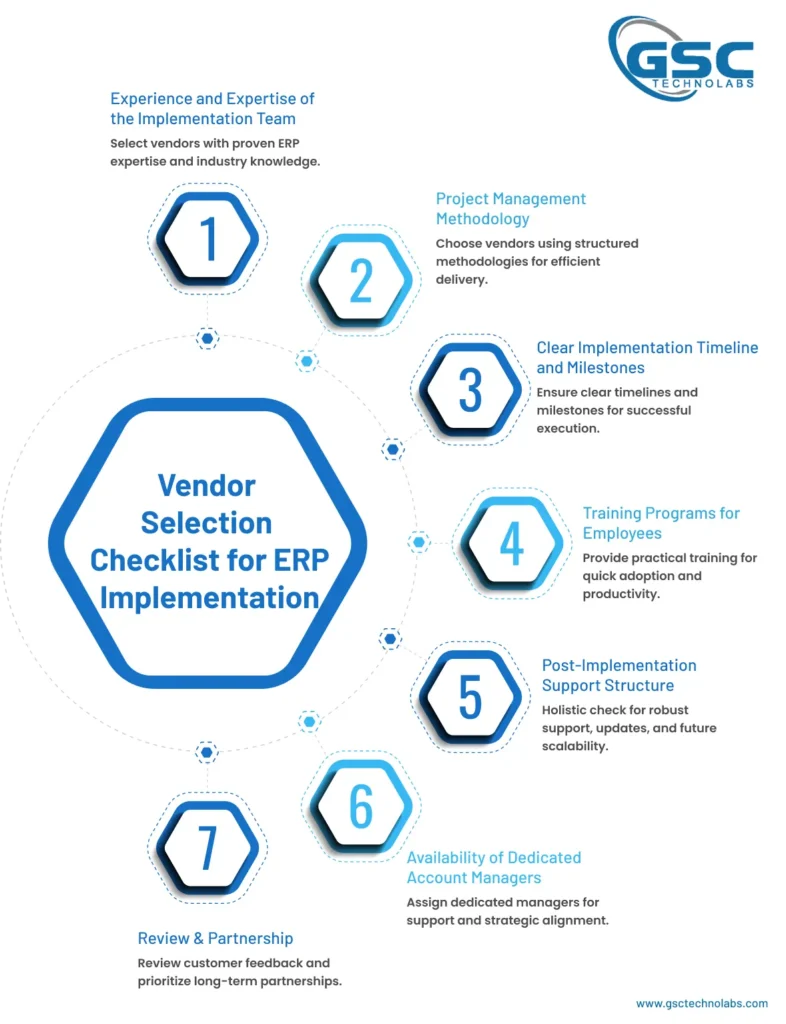
This structured approach ensures you select an ERP vendor that not only meets your current operational needs but also supports long-term business expansion and digital transformation.
Here is what to consider while going for a Vendor for ERP implementation-
A vendor with strong experience has likely handled multiple ERP projects across industries.
Why it matters:- They can anticipate problems early and avoid costly mistakes
- Provide best practices instead of trial-and-error approaches
- Ensure smoother customization and integration with your existing systems
Inexperienced teams can cause delays, errors, or even project failure.
This refers to how the vendor plans, executes, and monitors the project (e.g., Agile, Waterfall).
Why it matters:- Ensures structured execution and proper coordination
- Helps in tracking progress and managing risks
- Keeps all stakeholders aligned and informed
Without a clear methodology, projects often become disorganized and exceed budget/time.
A defined schedule with measurable checkpoints is essential.
Why it matters:- Helps you monitor progress step-by-step
- Identifies delays early so corrective action can be taken
- Keeps the project on track and within deadlines
Lack of timelines can lead to indefinite delays and increased costs.
ERP systems are only effective if employees know how to use them.
Why it matters:- Improves user adoption and productivity
- Reduces resistance to change
- Minimizes errors in system usage
Without proper training, even the best ERP system can fail due to poor usage.
Support after the system goes live is critical.
Why it matters:- Helps resolve technical issues quickly
- Ensures system updates and improvements
- Keeps business operations running smoothly
ERP systems often need adjustments after deployment, so ongoing support is essential.
A dedicated point of contact improves communication and accountability.
Why it matters:- Ensures quick response to queries or issues
- Provides personalized attention to your business needs
- Improves coordination between your team and the vendor
Without a dedicated manager, communication gaps can slow down problem-solving.
Strong implementation support reduces risks, speeds up adoption, and ensures a smoother transition to the new system.Evaluating a vendor’s reputation helps you understand their reliability and long-term value.
Why it matters- Provides insight into real-world performance through customer reviews and testimonials
- Highlights credibility through recognized certifications and quality standards
- Demonstrates technical strength via established technology partnerships
- Reflects industry trust through strategic alliances with reputable organizations
A strong track record and reputable partnerships indicate that the vendor is committed to delivering quality, staying up to date with industry standards, and supporting clients effectively over time.
Demos and trials are the best methods of evaluating the ERP systems. Ask vendors that are shortlisted to give demos and make sure they address your business processes of interest.
Demo checklist:
1. Implementation & Setup
- How long does implementation typically take?
- What level of vendor support is provided during implementation?
- Is data migration from current systems easy?
2. Integration Capabilities
- Does the ERP integrate with accounting software, CRM, HR tools, and e-commerce platforms?
- Are APIs available for third-party integrations?
- How well does it synchronize data between modules?
3. Scalability
- Can the system handle business growth (more users, transactions, branches)?
- Is it suitable for multi-location or multi-company operations?
4. Security & Access Control
- Does the system support role-based access control?
- How is sensitive data protected?
- Does it provide audit trails for transactions?
5. Does the system slow down during peak usage?
- How fast is the system when handling large datasets?
- Does the system slow down during peak usage?
6. Mobile & Remote Access
- Is there a mobile app available?
- Can employees access the ERP remotely and securely?
7. Training & User Support
- Does the vendor provide training materials or onboarding sessions?
- Is customer support available 24/7?
- Are documentation and tutorials available?
8. Reporting & Dashboards
- Are dashboards customizable?
- Can reports be exported to formats like Excel, PDF, or CSV?
- Are real-time analytics available?
9. Compliance & Regulations
- Does the ERP support tax regulations and compliance relevant to your region?
- Are financial standards supported?
10. Cost Transparency
- What are the licensing costs?
- Are there additional costs for customization, upgrades, or support?
- What is the total cost of ownership?
11. Backup & Disaster Recovery
- How frequently is data backed up?
- What is the recovery process in case of system failure?
12. User Feedback During Trial
- Are employees comfortable using the system?
- How much training do users need before they can work efficiently?
Use real users, such as finance, sales, and operations departments as part of tests. Their response is essential to the insights of usability and adoption.
ERP system selection is not an easy task and there is always a possibility that an enterprise makes a wrong choice and thus does not succeed or fails to do it on time.
Common mistakes include:
- Selecting by the price factor alone: a low-cost ERP can be missing in terms of features or support.
- Neglect of scalability: The system should be able to accommodate the future growth and expansion.
- Omission of stakeholders: ERP implementation has implications on various departments.
- Lack of appreciation of training and change management: User adoption is essential.
- Failure to think about integration requirements: ERP should be able to integrate with the existing systems.
These errors are not to be repeated, and you will have a better chance of a successful implementation of the ERP.
What is an ERP system, and why does my business require an ERP system?
An ERP solution is an integrated computer application that assists companies in controlling major operations, including finance, inventory, sales, and human resources. ERP is essential to businesses in order to allow them to streamline their business, enhance efficiency, and gain real-time insights.
How do I know if my business needs an ERP now?
When your business is experiencing data silos, manual operations, slow reporting, or high growth rates, it is high time to consider ERP.
What are the criteria that I use to select an ERP vendor?
Some of the factors to consider are functionality, scalability, budget, support, industry expertise, and integration capabilities.
What is the duration of ERP implementation?
The timeframes of implementation also depend on the complexity of a business.
Is the ERP customizable to my business?
Yes, the majority of ERP systems are customizable; still, it is necessary to select a vendor that can meet your particular needs.
Choosing the right ERP system is a critical decision that can shape your business’s future. At GSC Technolabs, we specialize in helping businesses select and implement the perfect ERP solution tailored to your needs.
Ready to take your business operations to the next level? Contact GSC Technolabs today to get expert guidance on selecting and implementing the best ERP system for your company.
Specific IT Needs?

GSC Technolabs is a trusted IT solutions provider delivering tailored services that combine technical expertise with a customer-first approach. From cloud transformation and consulting to enterprise software implementation, application development, and data-driven insights, we enable organizations to streamline operations, enhance performance, and achieve long-term growth.


![Businessperson holding a tablet with a glowing 'ERP' icon and digital, interconnected tech graphics.]](https://www.gsctechnolabs.com/wp-content/uploads/2026/04/erp_vendor.png "erp_vendor - GSC Technolabs")